
CeraVe and Cetaphil – As people have become more conscious about their skin, this is the reason they are paying attention to the skin product they are buying. One of the most popular brands growing today is CeraVeand Cetaphil. These brands have gained a reputation for their gentle and effective formulas.
If you are considering purchasing CeraVe, it is advisable to check CeraVe reviews to know if it will suit your skin. These brands offer a wide range of products designed to nourish, protect and hydrate the skin, making them ideal for sensitive or dry skin. The purpose of this article is to provide you with a summary of both products.
Table of Contents
About CeraVe and Cetaphil
Here’s a side-by-side table indicating CeraVe and Cetaphil to highlight what each product is known for and how they vary:
| Feature | CeraVe | Cetaphil |
| Brand Focus | Skin care with barrier repair and hydration as core goals | Ultra-gentle and negligible skincare for sensitive skin |
| Founded | 2005 | 1947 |
| Typical Key Ingredients | Ceramides, hyaluronic acid, niacinamide | Glycerin, panthenol, mild surfactants |
| Formula Style | Often comprises science-backed activities and advanced delivery tech | Simple, low-irritation formulas with fewer actives |
| Texture Range | Creams, lotions, gels — from rich to lightweight | Mostly lightweight lotions, gels, and non-foaming cleansers |
| Best For | Dry, dry, compromised, or textured skin | Very sensitive, reactive, or irritation-prone skin |
| Acne-Targeted Options | Yes — some salicylic acid formulas | Limited acne-specific products |
| Barrier Repair Support | Robust emphasis | Present but less targeted |
| Mildness | Gentle but with activities | Actual gentle and soothing |
| Typical Price Position | Slightly advanced on average | Generally slightly more affordable |
| Dermatologist Use | Widely optional for barrier/eczema concerns | Widely recommended for sensitive/reactive skin |
What Are CeraVe and Cetaphil?
Before comparison specifics, let’s briefly describe each brand.
What Is CeraVe?
CeraVe is a skincare brand developed with dermatologists and backed by modern formulation technology. Its products focus on supporting the skin barrier with key ingredients such as ceramides, hyaluronic acid, and niacinamide.
CeraVe highlights science-based formulations with patented delivery systems to improve long-term skin health. It’s widely used for dry, compromised, or flaky skin.
What Is Cetaphil?
It is another dermatologist-trusted brand known for simple, gentle, non-irritating skincare. Cetaphil products are often fragrance-free, clinically tested, and formulated to cleanse and moisturize without needless actives.
Cetaphil tends to be well-liked for reactive or sensitive skin — especially skin that tends to get easily irritated.
CeraVe vs Cetaphil: Ultimate Skincare Brand Comparison
Skincare shoppers often ask: Which is better, CeraVe or Cetaphil? Both brands are extremely popular, dermatologist-recommended, and are considered gentle choices for sensitive skin. But they aren’t vague. This deep, informative comparison breaks down changes in formulation, performance, price, texture, and who each brand is best suited for.
Whether you’re building your first routine or reevaluating your products, this article will help you make confident choices.
| Feature | CeraVe | Cetaphil |
| Brand Philosophy | Focus on barrier repair and hydration | Focus on gentle, low-irritation skincare |
| Core Strengths | Ceramides, hyaluronic acid, niacinamide | Very mild surfactants, glycerin, panthenol |
| Formula Complexity | More functional actives, some targeted treatments | Simpler, minimal formulas |
| Best For | Dry, compromised, textured, or dehydrated skin | Extremely sensitive or reactive skin |
| Cleansers | Hydrating and foaming options | Ultra-gentle, low-foam or no-foam options |
| Moisturizers | Barrier-focused creams and lotions | Light, soothing hydration |
| Acne-Focused Products | Yes (e.g., BHA options) | Limited |
| Sunscreen Options | Hydrating SPF formulas | Lightweight SPF with gentle feel |
| Texture Range | Rich creams to lightweight gels | Mostly light gels/lotions |
| Typical Price Position | Slightly higher on average | Generally slightly more affordable |
| Dermatologist Recommendation | Strong for barrier repair and hydration | Strong for sensitive/reactive skin |
CeraVe vs Cetaphil for Acne
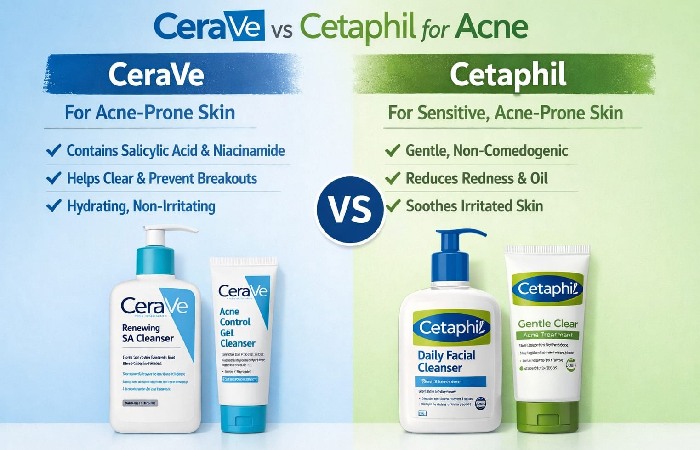
For acne-prone skin, CeraVe tends to be more effective, as several of its cleansers and conditioners contain acne-friendly ingredients (like ceramides with niacinamide and options with salicylic acid) that help reduce breakouts and support skin repair without over-drying.
| Feature | CeraVe | Cetaphil |
| Acne-specific ingredients (e.g., salicylic acid) | ✔ (in some products) | ✘ (limited) |
| Barrier support (helps decrease irritation from acne products) | ✔ | ✔ (gentle but less targeted) |
| Best for mild to reasonable acne | ✔ | (better as a gentle cleanser) |
| Best for very sensitive/reactive acne | 0 | ✔ |
| Overall acne efficiency | Higher | Moderate |
Which is More Expensive, CeraVe or Cetaphil?
In general, CeraVe products are slightly more luxurious than Cetaphil products — but the difference isn’t huge. CeraVe’s preparations often include original technologies (such as its MVE system), ceramides, and other active ingredients, which can increase manufacturing and retail costs compared with Cetaphil’s simpler, gentler formulas. As a result, CeraVe tends to sit at a slightly higher average price point, while Cetaphil usually offers more budget-friendly options, particularly for basic cleaners and moisturizers.
Key points:
CeraVe typically has a somewhat higher price range, generally, especially for specialized products.
Cetaphil is often more reasonable, with prices generally a bit lower for similar rudimentary products.
Features of CeraVe and Cetaphil
| Feature | CeraVe | Cetaphil |
| Core actives | Ceramides, hyaluronic acid, niacinamide | Glycerin, panthenol, niacinamide |
| Skin focus | Barrier repair, hydration, targeted concerns | Sensitive skin, ease, minimal annoyance |
| Texture | Thicker, more emollient | Lighter, non-greasy |
| Specialized crops | More: exfoliating, acne, eczema-targeted | Fewer activities, gentle daily basics |
| Best for | Dry/eczema-prone, barrier repair | Very sensitive or reactive skin |
| Price range | Similar, infrequently slightly higher | Generally affordable and simple |
Key Ingredient Differences of CeraVe and Cetaphil
Empathetic, the ingredients help explain why these make
CeraVe’s Signature Ingredients
Ceramides (1, 3, 6-II) — restore barrier lipids
Hyaluronic Acid — attracts and holds moisture
Niacinamide — calms annoyance
MVE Technology — long-lasting hydration delivery
These ingredients are beneficial for dry, dehydrated, and barrier-compromised skin.
Cetaphil’s Typical Ingredients
Glycerin — humectant hydration
Panthenol — soothing and moisturizing
Mild surfactants — non-stripping cleansing
Rarely uses ceramides or active boosters
Cetaphil evades strong actives, making it especially mild on sensitive or redness-prone skin.
CeraVe vs Cetaphil SA Cleanser
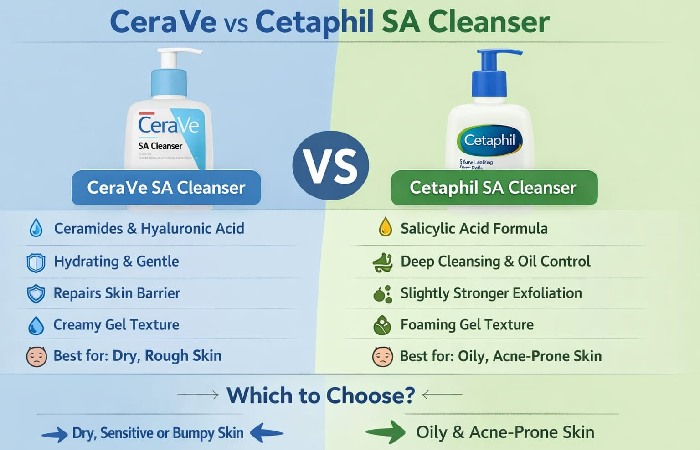
Here’s a contrast table for the salicylic-acid exfoliating cleansers from CeraVe and Cetaphil — focusing on their key benefits and changes:
| Feature | CeraVe SA Smoothing Cleanser | Cetaphil Gentle Exfoliating SA Cleanser |
| Primary purpose | Exfoliating + smoothing rough, bumpy skin with salicylic acid | Gentle exfoliation with salicylic acid + other AHA/BHA blend |
| Key actives | Salicylic acid (BHA) + ceramides | Salicylic acid (BHA) + mandelic acid + gluconolactone (AHA), glycerin |
| Texture | Gel / creamy exfoliating cleanser | Lightweight foaming gel |
| Barrier support | Includes ceramides for hydration & barrier repair | Emphasizes more on gentle exfoliation + soothing ingredients |
| Best for | Rough, textured, and acne-prone skin needing exfoliation + hydration | Sensitive skin that wants gentle chemical exfoliation |
| Skin feel after use | Somewhat more hydrating | Light, stimulating |
| Typical strength | Normal salicylic acid exfoliant | Combined SA with additional acids for wider exfoliation |
Cleansers of CeraVe vs. Cetaphil
Cleansers are where most people start comparing the brands.
CeraVe Cleansers
- CeraVe has several cleansers formulated for different skin needs:
- CeraVe Hydrating Cleanser — soft, great for dry and sensitive skin
- CeraVe Foamy Cleanser — gel wash for normal to oily skin
- CeraVe SA Smoothing Cleanser — comprises salicylic acid for texture
CeraVe cleansers tend to:
- Gently cleanse without stripping
- Add hydration with humectants
- Support the skin barrier
They are suitable for daily use and for beleaguered concerns, such as mild acne or feelings when salicylic acid is included.
Cetaphil Cleansers
- Cetaphil Gentle Skin Cleanser — classic no-foam wash
- Cetaphil Oily Skin Cleanser — safer for oilier skin
- Cetaphil PRO Derma control Oil-Removing Foam Wash — for mixture to oily skin
Cetaphil cleansers are:
- Mild and soothing
- Less likely to trigger irritation
- Good for very sensitive or post-procedure skin
Cleanser Comparison Summary
| Feature | CeraVe | Cetaphil |
| Barrier-supporting ingredients | ✔ | ✘ |
| Slightly more active options | ✔ | ✘ |
| Ultra-minimal preparation | ✘ | ✔ |
| Best for acne or surface skin | Some options | Limited. |
Sunscreen Comparison Of CeraVe vs Cetaphil
When comparing sunscreens from the two brands, CeraVe sunscreens tend to focus on barrier-supporting skincare with ceramides and hydrating ingredients alongside sun protection. In contrast, Cetaphil tan lotion usually offers higher SPF and a very gentle, lightweight defense, often preferred for subtle or oily skin. Together, they offer broad-spectrum UV protection, but Cetaphil choices (like SPF 50+) usually deliver stronger sun defense and a lighter finish.
| Feature | CeraVe AM Facial Moisturising Lotion SPF50 & CeraVe Invisible Hydrating Sunscreen SPF50+ | Cetaphil Sun SPF 50+ Light Gel & Cetaphil Sun SPF 30 Light Gel Sunscreen |
| SPF Rating | SPF 50 (and variants) | Generally, SPF 50+ and SPF 30 options are available |
| Texture | Hydrating, slightly creamier | Frivolous, non-greasy gel |
| Skin Type Suitability | Best for normal to dry or sensitive skin needing extra hydration | Excellent for sensitive, combination, or oilier skin |
| Barrier Support | Comprises ceramides & hydrating actives | Focuses more on sun protection and a mild feel |
| Finish | May feel richer | Characteristically more sheer and matte |
Moisturizers: Hydration & Repair of CeraVe and Cetaphil
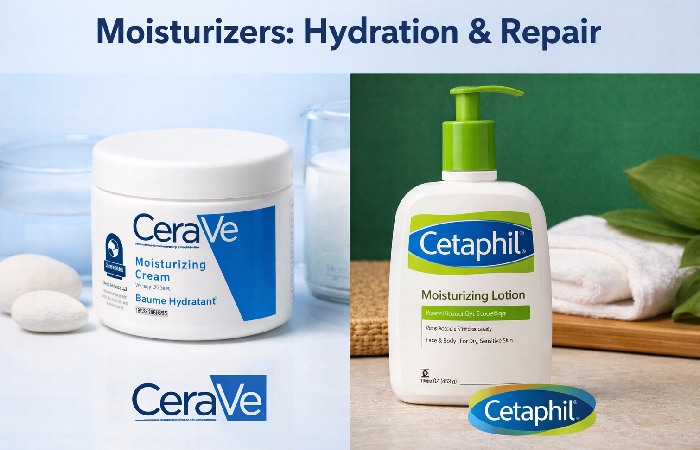
CeraVe Moisturizers
CeraVe moisturizers are formulated to restore and protect the skin barrier.
Popular options include:
- CeraVe Moisturizing Cream — rich and penetrating hydration
- CeraVe Daily Moisturizing Lotion — everyday use
- CeraVe PM Facial Moisturizing Lotion — a nightly moisturizer.
Cetaphil Moisturizers
Cetaphil moisturizers are designed for simplicity and tolerance:
- Cetaphil Creaming Lotion — lightweight hydration
- Cetaphil Rich Hydrating Night Cream — hyaluronic acid focus
- Cetaphil PRO Eczema Soothing Moisturizer — for flares
Moisturizer Comparison Summary
| Feature | CeraVe | Cetaphil |
| Strong barrier support | ✔ | ✘ |
| Deep hydration | ✔ | ✔ |
| Best for eczema | Better choices | Some options |
| Simple formula | ✘ | ✔ |
Price in India, UK, USA, And London of CeraVe vs Cetaphil
|
Region |
Typical CeraVe Price | Typical Cetaphil Price | Notes |
| India | CeraVe Moisturizing Cream ~₹1,000–₹3,000+ | Cetaphil Gentle Skin Cleanser ~₹1,600–₹2,000+ | CeraVe is often somewhat higher for moisturizers/cleansers, in a wide range. |
| UK (general) | CeraVe moisturizers/cleansers typically ~£10–£20+ | Cetaphil cleansers/moisturizers ~£7–£12+ | Cetaphil is often cheaper, though close in price. |
| London (UK) | Similar to UK valuing (£10–£20+) | Similar to UK pricing (£7–£15+) | London retail follows broader UK drugstore ranges. |
| USA | CeraVe Hydrating Cleanser ~$15–$20 | Cetaphil Daily Cleanser ~$11–$15 | Cetaphil is typically slightly cheaper; exact prices vary by the shop. |
Performance by Skin Type of CeraVe and Cetaphil
Everyone’s skin is different — so here’s how each brand performs on various types.
Dry & Dehydrated Skin
CeraVe: Excellent for reinstating moisture and repairing the barrier
Cetaphil: Good hydration, but may not recover long-term barrier strength
Winner: CeraVe
Oily or Combination Skin
CeraVe: Gel cleansers and gel moisturizers work well
Cetaphil: Light cleansers and lotions are well-tolerated
Winner: Tie (be contingent on texture preference)
Sensitive or Reactive Skin
CeraVe: Generally gentle, but sturdier actives may irritate
Cetaphil: Very well-tolerated and low-irritant
Winner: Cetaphil
Acne-Prone Skin
CeraVe: Some crops comprise salicylic acid and niacinamide
Cetaphil: Focuses on cleansing; incomplete acne-specific options
Winner: CeraVe.
Conclusion
Checking feedback on CeraVe and Cetaphil skincare products will give you more insight into these products. These brands offer gentle formulas free from fragrances, parabens, and sulfates, making them suitable for sensitive skin. Additionally, both brands offer products that provide long-lasting hydration to the skin. It helping to reduce the appearance of fine lines and wrinkles. You can choose CeraVe, Cetaphil, or any other hydrating moisturizer that gives a high-quality, effective, and gentle skincare solution.
