

Best Face Moisturiser For Every Skin Type – Are you searching for the ideal moisturizer to use on your facial skin in India? If it’s the perfect moisturizer for your face, hands, body, or even the face, it’s essential for anyone who wants radiant and healthy skin. Find out why moisturizers are so crucial, when you should use this product, and what kinds of moisturizers you require. If you study this article, you’ll be able to determine your top choice to hydrate your skin.
Table of Contents
How to Choose the Right Face Moisturiser for Your Skin Type?
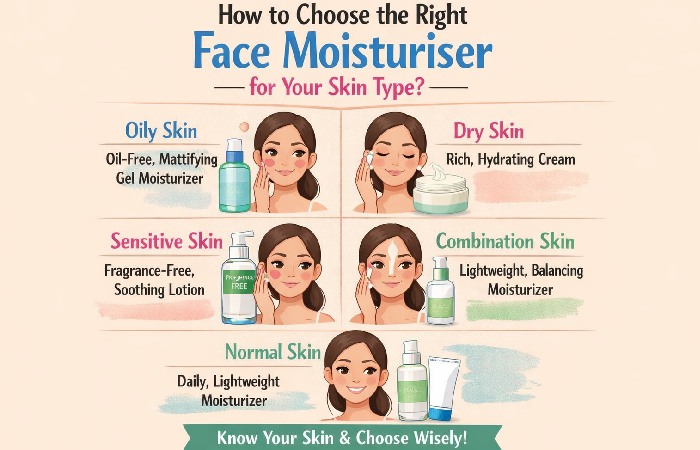
Choosing the right face moisturiser is essential for maintaining healthy, balanced, and healthy-looking skin. Each skin type has diverse needs, and using the wrong product can lead to dryness, extra oiliness, breakouts, or irritation. A good moisturiser helps protect the skin’s barrier, lock in hydration, and improve skin feel. Understanding your skin type and checking ingredient labels can help you select a product that works well for you.
| Skin Type | Ideal Texture | Key Ingredients to Look For | Ingredients to Avoid | Benefits |
| Dry Skin | Thick cream/balm | Hyaluronic acid, ceramides, shea butter, squalane | Alcohol, strong fragrance | Deep hydration stops flaking |
| Oily Skin | Light gel / water-based | Niacinamide, hyaluronic acid, green tea, salicylic acid | Heavy oils, petrolatum | Hydrates without greasiness |
| Combination Skin | Gel-cream / light lotion | Glycerin, ceramides, aloe vera | Very heavy creams | Balances dry and oily areas |
| Sensitive Skin | Fragrance-free cream/lotion | Ceramides, panthenol, aloe vera, oat extract | Perfume, parabens, dyes | Soothes irritation, protects the barrier |
| Normal Skin | Light cream/lotion | Hyaluronic acid, vitamin E, peptides | Harsh chemicals | Maintains healthy moisture balance |
What are the Advantages of Using a Moisturizer for your Face?
A moisturizer to prepare your face before applying makeup is an essential part of a healthy routine for skincare. In reality, there are three essential steps to the foundation of a good beauty routine: proper cleanse, deep moisturizing, and applying SPF. You can add additional steps; however, these three steps aren’t recommended to skip in any way. A healthy hydration routine can do a lot of things to your skin and aid in looking your absolute best.
After cleansing, moisturizing cream helps restore your skin’s natural barrier, as your skin requires to be hydrated and hold on to water.
Because collagen is lost after age 30, the skin loses elasticity and becomes thin and dryer. Regular skin hydration is a great way to ease these issues. However, age spots, wrinkles, and flakiness could develop before it is too late.
A moisturizing cream creates a barrier over your face, cold or hot weather, and pollution from the air while preventing damage and irritation.
Applying moisturizer to the face before bed can help reduce wrinkles and wrinkles that develop after a night of sleep.
Top Ingredients to Look for in a Quality Face Moisturiser
A good face moisturiser does more than hydrate the skin — it helps repair the skin barrier, stop moisture loss, calm annoyance, and improve overall skin feel. The effectiveness of a moisturiser mostly hinges on its ingredients. Choosing foodstuffs with scientifically proven hydrating and skin-repairing components safeguards your skin from drying out, keeps it healthy, and protects it from environmental damage. Whether your skin is dry, oily, sensitive, or a mix, certain ingredients offer universal benefits and enhance your skincare routine.
Key Ingredients to Check
Hyaluronic Acid — An influential humectant that attracts moisture into the skin, keeping it plump, flat, and hydrated without feeling heavy or greasy.
Ceramides — Essential lipids that strengthen the skin barrier, stop water loss, and defend against pollution and environmental harm.
Glycerin — A mild hydrating ingredient that draws moisture from the air into the skin, making it soft and supple.
Niacinamide (Vitamin B3) — Helps control oil production, minimize pores, reduce redness, and improve rough skin tone.
Shea Butter — A rich, normal moisturizer that intensely feeds dry skin and restores bounce.
Squalane — A lightweight, non-comedogenic oil that mimics the skin’s natural sebum and provides deep hydration without clogging pores.
Aloe Vera — Known for its soothing properties, it helps reduce annoyance, redness, and inflammation.
Panthenol (Vitamin B5) — Helps retain moisture, softens skin, and supports the healing of damaged or sensitive skin.
Peptides — Support collagen production, improve skin firmness, and help decrease fine lines and wrinkles.
Vitamin E — A powerful antioxidant that protects skin from free radical damage while improving moisture retention.
Gel vs Cream Moisturisers: Which One Suits You Better?
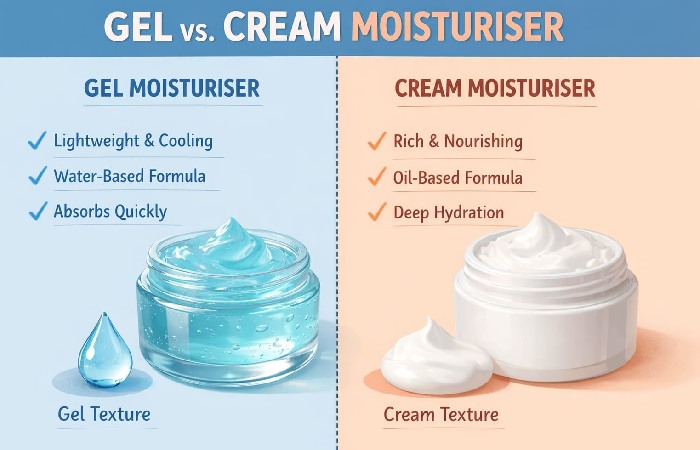
Choosing between gel and cream moisturisers depends on your skin type, climate, and personal comfort. Both types are designed to hydrate the skin, but they differ in texture, preparation, and how they interact with your skin. Gel moisturisers are usually water-based, frivolous, and fast-absorbing, making them ideal for those who prefer a non-greasy feel. Cream moisturisers, on the other hand, are thicker and oil-based, offering deeper nourishment and forming a protective barrier that prevents moisture loss.
Understanding these differences helps you select the moisturiser that keeps your skin balanced, healthy, and happy through the day.
Quality
Gel moisturisers have a light, jelly-like texture, while cream moisturisers are thick, rich, and smooth.
Best for Skin Type
Gels are perfect for oily, acne-prone, and combination skin, whereas creams are perfect for dry, very dry, and sensitive skin.
Hydration Level
Gels provide light-to-moderate hydration; creams deliver deep and long-lasting moisture.
Absorption Speed
Gel formulations absorb quickly into the skin without leaving a residue. Creams take longer to absorb but provide permanent nourishment.
Oil Content
Gels are characteristically oil-free or low in oil, while creams cover more oils and balms.
Climate Suitability
Gel moisturisers work best in hot and humid weather. Cream moisturisers are better for cold, dry, or winter climates.
Finish on Skin
Gels leave a fresh, matte finish. Creams leave a soft, dewy, and moisturised finish.
Makeup Compatibility
Gels sit well under makeup due to their lightweight texture. Creams may feel heavy, but they are ideal for nighttime skincare.
Expert Tips to Apply Moisturiser for Maximum Benefits
Applying moisturiser appropriately is just as important as picking the right produce. A proper request helps your skin retain hydration effectively, reinforces the skin barrier, and enhances the efficacy of other skincare products. Many people apply moisturiser incorrectly by using too much product, rubbing too hard, or applying it to completely dry skin — all of which reduce its effectiveness. Using the right technique ensures long-lasting hydration, smoother texture, and healthy-looking skin.
| Step | Expert Tip | Why It Matters |
| 1 | Cleanse your face before smearing moisturiser | Removes dirt and oil so skin absorbs hydration more healthily |
| 2 | Apply to somewhat damp skin | Locks in moisture and recovers hydration, holding |
| 3 | Use a pea-sized amount for the face | Stops product buildup and stops pores |
| 4 | Dot moisturiser on forehead, cheeks, nose, and chin | Safeguards even distribution |
| 5 | Gently kneading in upward circular motions | Recovers absorption and prevents skin pull |
| 6 | Do not forget the neck area | Neck skin also needs hydration and anti-aging care |
| 7 | Apply light layers instead of a thick coating | Helps skin breathe and prevents greasiness |
| 8 | Use gel moisturiser during the day and cream at night | Delivers balanced hydration based on skin needs |
| 9 | Wait 1–2 minutes before smearing sunblock or makeup | Allows moisturiser to absorb fully |
| 10 | Moisturise twice daily | Upholds skin barrier and prevents dryness |
Natural and Organic Face Moisturisers for Gentle Skincare
Natural and organic face moisturisers are formulated with plant-derived ingredients that hydrate the skin while minimizing synthetic materials, fragrances, and harsh preservatives. These crops are particularly popular for sensitive, dry, or irritated skin because they focus on strengthening the skin barrier with gentle, antioxidant-rich botanicals and nourishing oils.
| Natural Ingredient | Source | Skin Benefit |
| Aloe Vera Gel | Aloe plant | Hydrates deeply, soothes annoyance |
| Shea Butter | Shea nut | Rich emollient for dry, flaky skin |
| Jojoba Oil | Jojoba plant | Equilibria oil production, non-comedogenic |
| Coconut Oil | Coconut fruit | Deep moisturisation (best for dry skin) |
| Rosehip Seed Oil | Wild rose seeds | Rich in antioxidants & fatty acids |
| Chamomile Extract | Chamomile flowers | Calms redness, anti-inflammatory |
| Green Tea Extract | Tea leaves | Antioxidants protect against free radicals |
| Olive Squalane | Olive oil derivative | Lightweight hydration, recovers elasticity |
| Cucumber Excerpt | Cucumber plant | Stimulating, cooling, hydrating |
| Honey | Bees | Natural humectant, retains dampness |
Key Differences Between Gel and Cream Moisturisers for Every Skin Type
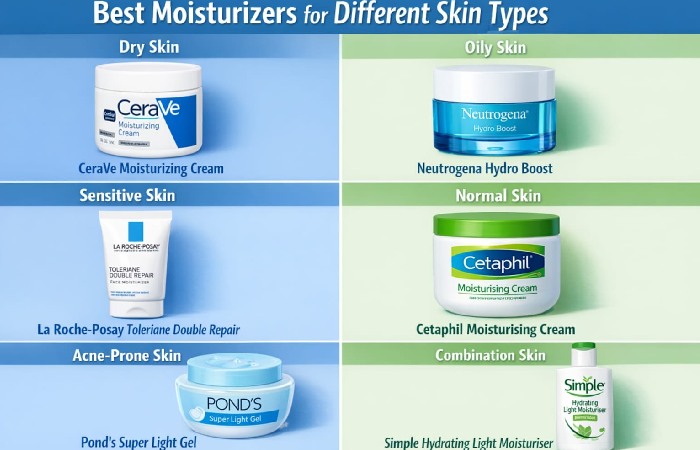
It helps you choose whether a gel or cream moisturiser suits your skin type and supplies better:
| Feature | Gel Moisturisers | Cream Moisturisers |
| Texture | Lightweight, jelly-like | Profuse, rich, creamy |
| Best for Skin Types | Oily, mixture, acne-prone | Dry, very dry, sensitive |
| Hydration Level | Light to moderate | Deep and ongoing |
| Absorption | Fast, non-greasy | Slower, richer feel |
| Oil Content | Typically oil-free or low oil | Higher in creams and oils |
| Climate Suitability | Hot, humid weather | Cold, dry weather |
| Finish on Skin | Fresh, matte | Soft, dewy |
| Makeup Compatibility | Outstanding under makeup | May feel heavy under makeup |
| Breakout Risk | Lower (non-comedogenic gels) | Slightly advanced if heavy oils are used |
| Best Ingredient Focus | Hyaluronic acid, aloe, niacinamide | Ceramides, shea butter, squalane |
| Ideal For | People who dislike heaviness | Those needing deep nourishment |
| Day/Night Use | Great for daytime | Best for night or dry periods |
When and how often should I Apply a Moisturizer to my Face?
Applying a good moisturizer helps keep your skin hydrated, soft, and protected. Products with ingredients like Hyaluronic acid or Glycerin help retain moisture and maintain healthy skin.
When to Apply Moisturizer
- After Washing Your Face
Apply moisturizer right after cleansing while your skin is still slightly damp. This helps lock in moisture. - In the Morning
Using moisturizer in the morning protects your skin from dryness, pollution, and environmental stress. - At Night
Nighttime application helps repair and hydrate the skin while you sleep. - After Exfoliating or Using a Face Mask
Moisturizing after exfoliation helps soothe and restore the skin barrier.
How Often Should You Apply It?
| Skin Type | Recommended Frequency | Reason |
| Dry Skin | 2–3 times daily | Dry skin loses moisture quickly |
| Normal Skin | 2 times daily | Maintains balanced hydration |
| Oily Skin | 1–2 times daily | Lightweight moisturizers prevent excess oil |
| Sensitive Skin | 2 times daily | Helps strengthen the skin barrier |
Types of Moisturizers for the Face
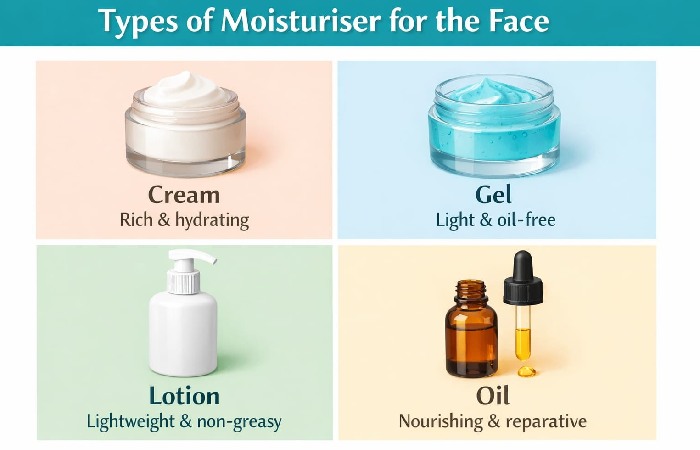
Many moisturizers are available; however, they can be categorized into a handful of categories appropriate for various skin types or conditions.
Gel Moisturizer for Face
The soothing gel moisturizers are ideal to use in the summertime for all skin types and all year long if you are prone to oily skin. If your skin’s condition drastically changes according to the season, you should opt for lighter and more refreshing products to moisturize your skin during the summer. The gel quickly absorbs and refreshes your skin without feeling too heavy or oily.
Moisturizing Cream
The cream moisturizer is one of the most sought-after products that come in this type. The face glow cream used for moisturizing is heavier than gels and is composed of water and oily emulsion. The majority of creams provide an extra layer of protection for your skin.
Face moisturizing Lotion
Lotions are lighter versions of creams. They can be applied with a creamy texture on humid and hot days when your skin doesn’t need additional nourishing and moisturizing. In other cases, you could apply a “moisturizer sandwich,” layering heavier products on lighter ones to ensure that your skin stays well-hydrated.
The Best Moisturizer that is Non-Comedogenic for Oily Skin
For oily or acne-prone skin, a non-comedogenic moisturizer is ideal because it hydrates the skin without clogging pores. These formulas are usually lightweight, oil-free, and contain ingredients such as glycerin, hyaluronic acid, niacinamide, and ceramides, which hydrate and strengthen the skin barrier without causing breakouts.
Below are some popular non-comedogenic moisturizers suitable for oily skin.
| Moisturizer | Skin Type | Key Ingredients | Main Benefits |
| CeraVe Oil Control Moisturising Gel Cream | Oily & acne-prone | Ceramides, niacinamide | Controls oil and strengthens skin barrier |
| Pond’s Super Light Gel | Oily & combination | Hyaluronic acid, vitamin E | Lightweight hydration without greasiness |
| Re’equil Oil Free Moisturiser | Oily & sensitive | Betaine, anti-inflammatory agents | Hydrates while regulating sebum production |
| The Derma Co. 5% Nia‑Ceramide Mattifying Moisturizer | Oily & acne-prone | Niacinamide, ceramides | Reduces oil and improves skin texture |
| Aqualogica Glow+ Hydra Gel Moisturizer | Oily & dull skin | Hyaluronic acid, vitamin C | Hydrates and brightens skin |
| Dot & Key CICA + Niacinamide Oil‑Free Moisturizer | Oily & sensitive | Cica, niacinamide | Calms irritation and controls oil |
Price in India, Best Face Moisturiser For Every Skin Type
Comparison table of prevalent face moisturisers available in India that suit dissimilar skin types, from dry and understated to oily and mixed. Prices are approximate and based on present online listings in India.
| Product | Best For | Approx. Price (₹) | Key Notes |
| Simple Hydrating Light Moisturiser | All skin types, especially sensitive | ~₹349 | Lightweight, non-greasy gel |
| Pond’S Super Light Gel | Oily / Combination | ~₹290 | Gel formula for normal use |
| Re’equil Ceramide & Hyaluronic Acid Moisturiser | Normal / Dry / Sensitive | ~₹265 | Barrier-friendly hydrating formula |
| Re’equil Oil Free Moisturiser | Oily / Acne-Prone | ~₹265 | Oil-free, light hydration |
| Cetaphil Moisturising Lotion | Dry / Sensitive | ~₹608 | Gentle, dermatologist-favourite |
| The Face Shop Rice Ceramide Moisturizing Emulsion | Normal / Dry | ~₹693 | Rich emulsion with ceramides |
| CeraVe Moisturizing Cream | Dry / Sensitive | ~₹366 | Barrier repair cream with ceramides |
| Nivea Soft Daily UV Light Moisturising Cream With SPF‑15 | All skin types / Daily | ~₹148 | With SPF, ordinary use |
| Neutrogena Hydro Boost Water Gel | Hydrating gel for all skin | ~₹339 | Hyaluronic acid gel |
| Lakme Peach Milk Moisturizer | Budget everyday | ~₹99 | Light, affordable |
| Dot & Key Super Bright Moisturizer | All skin types | ~₹425 | Improving + hydration |
| Deconstruct Oil-Free Moisturizer for Oily Skin | Oily / Mixture | ~₹297 | Non-greasy, frivolous |
| Foxtale Nourishing Face Moisturizer | All skin types | ~₹199 | Budget-friendly hydrating cream |
| Dr. Sheth’s Ceramide & Vitamin C Oil‑Free Moisturizer | Oily / Sensitive | ~₹234 | Ceramides + Vitamin C |
| Mamaearth Rice Dewy Bright Light Moisturizing Cream | Everyday hydration | ~₹351 | Bright, glass-skin feel |
Price in India, UK, USA, and London for Best Face Moisturiser For Every Skin Type
| Moisturiser | India (Approx) | UK / London (Approx) | USA (Approx) |
| Clinique Moisture Surge 100H Auto‑Replenishing Hydrator | ₹3,960+ | £30–£45 (~₹3,600–₹5,400) | $40–$55 (~₹3,300–₹4,500) |
| The Ordinary Natural Moisturizing Factors + HA | ₹850+ | £10–£18 (~₹1,200–₹2,100) | $14–$22 (~₹1,150–₹1,800) |
| Cetaphil Moisturising Cream (or Cetaphil Moisturising Lotion) | ₹790–₹1,070 | £12–£20 (~₹1,500–₹2,400) | $14–$24 (~₹1,150–₹2,000) |
| CeraVe Facial Moisturising Lotion / CeraVe Oil Control Moisturising Gel Cream | ₹1,020–₹1,105 | £5–£15 (~₹600–₹1,800) | $10–$18 (~₹800–₹1,450) |
| The Face Shop Rice Ceramide Moisturizing Emulsion | ₹693 | £15–£25 (~₹1,800–₹3,000) | $18–$28 (~₹1,450–₹2,250) |
| Re’equil Ceramide & Hyaluronic Acid Moisturiser | ₹265 | £8–£15 (~₹960–₹1,800) | $10–$20 (~₹800–₹1,600) |
| Dot & Key Barrier Repair Moisturizer | ₹336 | £10–£18 (~₹1,200–₹2,100) | $14–$22 (~₹1,150–₹1,800) |
| Neutrogena Hydro Boost Water Gel | ₹1,880 | £18–£28 (~₹2,200–₹3,400) | $20–$32 (~₹1,650–₹2,650) |
| Nivea Soft Light Moisturiser Cream | ₹138 | £5–£10 (~₹600–₹1,200) | $6–$12 (~₹500–₹1,000) |
| Foxtale Nutritious Face Moisturizer | ₹199 | £7–£12 (~₹840–₹1,440) | $8–$15 (~₹650–₹1,250) |
| Simple / Budget Gel (e.g., Simple, POND’S) | ₹64–₹379 | £6–£10 (~₹720–₹1,200) | $7–$12 (~₹575–₹1,000) |
How can I Pick the Best Moisturizing Product to Suit my Skin Type?
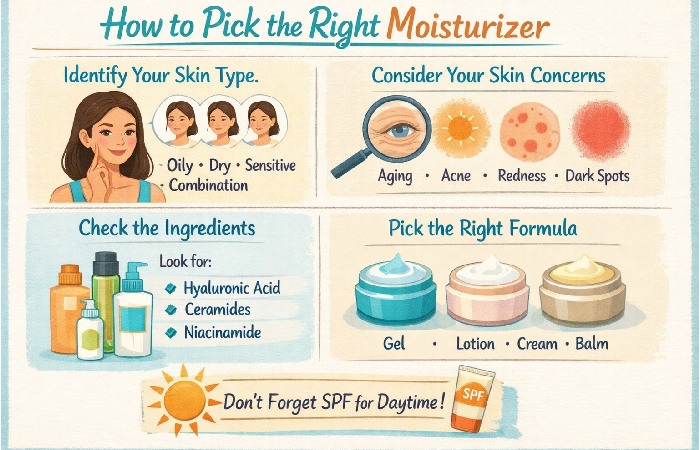
If you’re applying the wrong moisturizing product to suit your skin type, chances are you won’t see the results you’re hoping for. Learn how to select the right products suitable for your skin that don’t dry or cause it to become oily.
Best Moisturizer for Dry Skin
Moisturizers for dry skin can be utilized in the winter months when it is cold and cold. These are high-quality products that help reduce redness, skin sensitivity, and dryness to the skin. The best moisturizers for dry skin tend to have more hefty formulations, are enriched with oils, and assist in helping create a protective layer to keep skin moisturized.
Best Moisturizer for Combination Skin
As mentioned earlier, combination skin is split into distinct areas of dry skin, usually on the cheeks, and oily T-zone. There are various products available to treat each part, or stick with products labeled “for mixture skin”; they will moisturize dry areas without causing excessive breakouts or oiliness.
The Best Moisturizer for Oily Skin
It’s a huge mistake to believe that oily skin doesn’t require any type of moisturizer. It’s true that your skin could be dry and oily simultaneously, and, in this instance, it can produce more sebum. Therefore, it is essential to moisturize your face each moment after cleansing. If your skin is oily, you should choose lighter, less greasy, and quick-absorbing products.
Now that you have everything you require to moisturizer, why are you putting off getting started? Your skin will thank you for this!
Conclusion
Choosing the right face moisturiser is one of the simplest yet most impactful steps in any skincare routine, whether your skin is dry, oily, combination, sensitive, or normal. The perfect moisturiser not only hydrates your skin but also supports your skin’s natural barrier, reduces irritation, and restores your skin’s overall health and radiance.
FAQS
What does a face moisturiser do?
A face moisturiser hydrates the skin, prevents dryness, and protects the skin barrier.
How do I choose a moisturiser for my skin type?
Choice gel formulations for oily skin, rich creams for dry skin, and fragrance-free choices for sensitive skin.
Can greasy skin skip moisturiser?
No, oily skin still wants lightweight hydration to maintain balance and prevent extra oil production.
What ingredients are best in a moisturiser?
Hyaluronic acid, ceramides, glycerin, and niacinamide are key ingredients for healthy hydration.
Is gel moisturiser better than cream?
Gel suits oily and moist conditions, while cream is healthier for dry skin and cold weather.
How often should I apply face moisturiser?
Moisturiser must be practical, used twice daily, morning and night, after cleansing.
Can moisturiser help with acne?
Yes, oil-free and non-comedogenic moisturisers hydrate skin without blocking pores.
Should I apply moisturiser before sunscreen?
Yes, moisturiser first, then
Are natural moisturisers better for skin?
Natural moisturisers can be milder but should still complement your skin type and wants.
At what age should I start using moisturiser?
Moisturiser can be used from adolescence onward to maintain well-balanced skin.
